THE ETHER / ENVIRONMENT STUDY 001
NocturneDevelopment log.
The visual direction, materials, and production notes behind The Ether’s first playable chapter.
THE REGIONAL PLAN
The next landscape.
Review the connected watershed, giant-tree forest, industrial city, and hub in the regional atlas. This is a design study for the larger world.
Explore Nocturne Reach ↗THE FIRST PLAYABLE STUDY
Build the world one convincing place at a time.
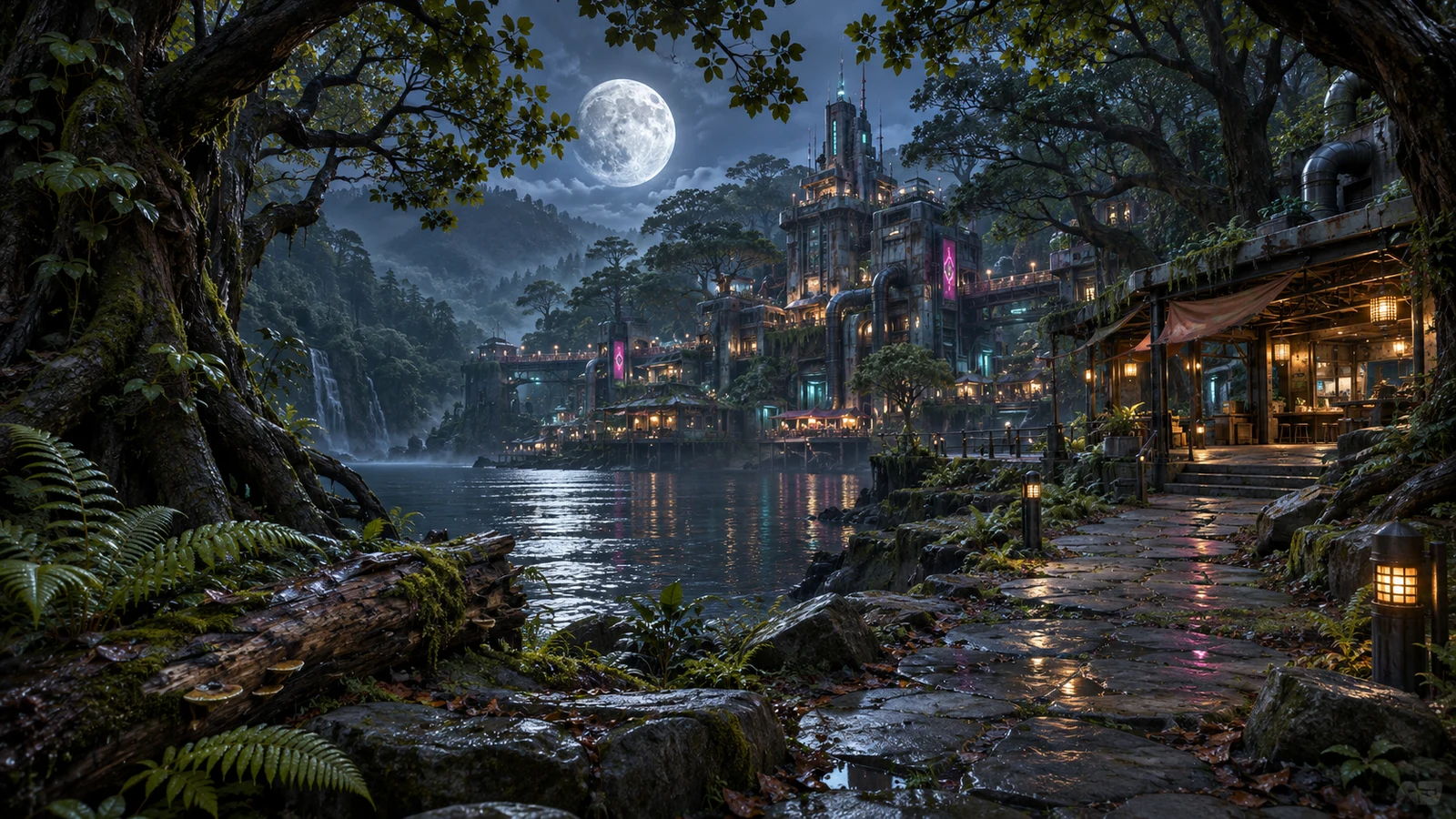
The current scene establishes the material palette and silhouettes: branching broadleaf trees, layered city buildings, a night-market shelter, a dark inlet, wet shale shelves, and fallen timber. The original Threshold, Workshop, and Observatory remain connected. A curved slate promenade leads into an open, lantern-lit waterfront pavilion with a working district-light terminal. A long pier crosses the wider inlet. The old station is lower and open to the sky, giving the forest and water more room.
Enter the playable study ↗01 / NATURAL FORMS
Silhouette before surface.
Original Blender meshes carry tapering trunks, irregular boughs, small curved leaves, broken rock strata, and exposed roots. Original generated bark, slate, and metal color tiles follow the concept’s palette. Independent photographic normals and roughness add microdetail; rock and soil retain their photographed color maps. These hybrid materials are not matched scans. Material briefs and provenance ↗ The trees and shale kit are original authored meshes. Captured mossy rocks from Poly Haven add a second source of natural surface detail.
02 / INHABITED STRUCTURES
Signs of a working city.
Recessed windows, panel seams, vents, pipes, balconies, and rain shelters give the buildings scale. Cyan and amber guide the eye; magenta stays rare. Most distant city buildings are scenery in this first study.
03 / LIGHT AND WATER
Let the moon do the work.
A coherent moon direction, reflection on rippled water, low mist, and readable dark foliage tie the scene together. The moon surface uses NASA’s CGI Moon Kit. HDR reflections and photographic surfaces remain self-hosted.
04 / THE WEB BUDGET
Detail where you can see it.
Tree instances share meshes and textures; far forest silhouettes use a transparent render of the original tree. Near and far versions bound geometry cost. City and shoreline assets stream after the arrival becomes playable. Adaptive resolution, low-power mode, and optional GPU-compressed maps remain available. Hardware performance still needs testing on representative phones.
RESEARCH / LEARNING FROM BATTLEFRONT
A production method, not an asset shortcut.
DICE’s 2016 photogrammetry talk documents the approach used for the 2015 Battlefront. It is a useful reference for capturing natural detail, but does not establish that every 2017 environment was scanned.
EA’s Frostbite lighting presentation directly describes Battlefront II’s baked indirect lightmaps, irradiance volumes, and dynamic direct lighting. The Emitter Graph presentation covers the tools behind its authored visual effects. This browser study uses a smaller rendering pipeline; it does not reproduce those engine systems.
No extracted Battlefront models, textures, or designs are included. EA’s content policy is not a reusable asset license for this independent project. Poly Haven’s CC0 library provides reusable natural models, maps, and HDRIs. Rock Moss Set 01 by Kless Gyzen is included here with its original UVs and photographed surface maps. The 1K source files are checked against the provider’s checksums before compression.